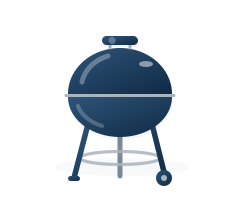
A grill on a wheeled cart moves easily across a flat patio and badly across everything else, and the route out of a back yard is rarely flat. Most of the prep is about making the grill smaller and cleaner before it has to travel.
Gas grills: the cylinder first
Close the valve on top of the propane cylinder, unscrew the regulator by hand, and lift the cylinder out of its holder. A propane cylinder is a separate item from the grill itself. Take it off, set it aside, and note it when you book.
Never leave a cylinder attached and on its side; stand it upright in a shaded spot away from the house until it goes.
Charcoal and pellet grills: empty them
Empty the ash pan or the bowl of a charcoal kettle, and run a pellet grill’s hopper empty or scoop the pellets out. Ash and pellets spill everywhere the moment a grill tilts.
Do this the day before, not the morning of. Ash that looks cold can hold heat overnight; a metal bucket with a lid is the safe place for it.
Make it smaller
Fold the side shelves. A grill with its shelves out can be a foot wider than with them folded.
Grates and flavorizer bars. Give the grates a scrape so grease doesn’t drip on the way out, or take them out and carry them separately.
Covers and tools. Take off the cover, the tool hooks and anything clipped to the sides.
Measure the gate
Side gates are routinely narrower than the front door. Measure the gate and any path between the patio and the street, and mention steps, gravel or a slope when you book.
Grill checklist
- Propane valve closed, cylinder off and set aside
- Ash or pellets emptied the day before
- Grates scraped or taken out
- Side shelves folded
- Cover and accessories off
- Gate and path measured
A grill starts at $90 on its own, or adds $35 to a pickup that’s already collecting something else from the yard or the house.